
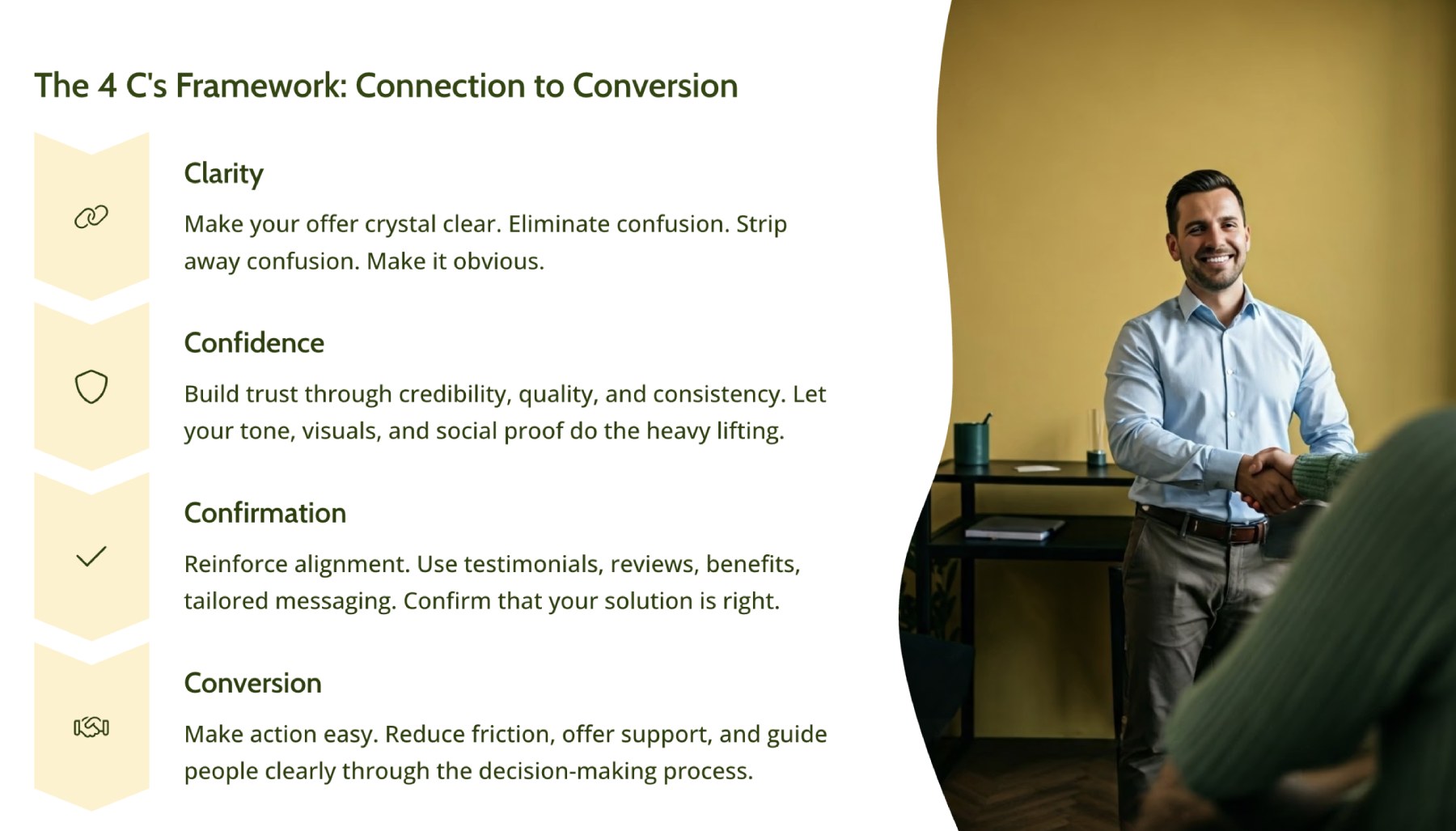
- Clarity: Strip away confusion. Whether it’s your message, design, or offer. Make it obvious. People don’t engage with what they don’t understand.
- Confidence: Build trust through credibility, quality, and consistency. Let your tone, visuals, and social proof do the heavy lifting.
- Confirmation: Reinforce alignment. Use testimonials, reviews, benefits, or tailored messaging to confirm that your solution is the right fit…now.
- Conversion: Make action easy. Reduce friction, offer support, and guide people clearly through the decision-making process.
⏱️ Total Estimated Read Time: 5 minutes
Code: COMP.DISCOVERY
Why the 4C’s Framework Works
In the early days of running my mobile cocktail bar business, I kept my ad spend lean. Around $70 a month on carefully chosen keywords. From that, I consistently locked in 2–4 bookings a week, sometimes more. These ranged from $500 all the way up to $10,000+. My cost per customer? Practically nothing.
I wasn’t just getting clicks. I was getting conversions. And I wasn’t just selling a service. I was guiding people through a process that felt natural, clear, and trustworthy.
The secret wasn’t a hack or some viral trick. It was a method I’ve now distilled into what I call the 4C’s Framework. A simple but powerful approach to shaping your customer journey from first contact to final conversion.
This article breaks down how Clarity, Confidence, Confirmation, and Conversion worked in the real world. And how you can apply it to your own service or business.
Clarity – Confidence – Confirmation – Conversion
Case Study : Mobile Cocktail Bar
This example led to a conversion rate of 70%.
Clarity
Strip away confusion.
Let’s face it…the idea of a mobile cocktail bar can be a little obscure. Many people would ask, “Where is it?” I’d explain, “It’s mobile…anywhere you like!” That’s when it would land: they could actually have a cocktail bar at their place, their office, or any venue they chose.
I’d hand them a card and say, “Check out the website and give me a call when you’ve got an event in mind.” That was one top-of-funnel strategy.
Another way to build inquiries was through online advertising, especially Google AdWords (as it was called then). Having a well-built website with information specific to what we were doing, and pointing the ad directly to what the customer wanted to hear, worked! People would land on the page, read about the mobile cocktail bar service, and be encouraged to make an inquiry by filling out the form.
Whether it’s your message, design, or offer…make it obvious!
People don’t engage with what they don’t understand.
Confidence
Code: COMP.DISCOVERY
Confidence
Build trust through credibility, quality, and consistency.
Credibility
In both examples above, credibility played out differently. In the face-to-face setting, having the presence of mind to give a quick pitch that suited the situation — and having a business card ready — was vital.
Online, after a few years of testing, I understood what keywords people were using to find my service. I used those in the AdWords ads and on the landing page. Once people arrived, they’d see the full website with detailed explanations and testimonials. This built credibility and lowered the barrier to inquiry.
Quality
In the in-person scenario, I demonstrated quality by being professional and knowledgeable about events and cocktails. I’d explain things like:
“It’s important to know how many glasses you’ll need. Ice can be tricky — but we take care of all that. All you have to do is supply the alcohol.”
Online, testimonials did a lot of the heavy lifting. I also had a few photos — this was before high-quality camera phones — and relied on an Instagram feed full of candid event shots. These showed real cocktail bars set up in all kinds of locations, with bartenders and people smiling, enjoying their drinks. It looked real — and it was. People would think, “Oh, I could have that at my place!”
Consistency
Because this was an innovative service, consistency was key. People needed to understand it was real and tangible. After a year or so of trading, things really picked up — I was able to present a consistent message, and that built momentum.
Let your tone, visuals, and social proof do the heavy lifting.
Tone
Early on, I did a brainstorming exercise with friends to choose the business name. I landed on 2010 Productions as the umbrella for an event services business. In hindsight, 2010 Event Services might have been clearer. But the name allowed me to grow from an entry-level Mobile DJ into a full event services business focused on Mobile Cocktail Bar offerings.
Visuals
I started with a photo gallery on the website. Then Facebook arrived…and at the time, business pages got organic reach and likes without needing ad spend. Later, Instagram became our go-to for visual proof.
Social Proof
After successful events, I’d follow up with a phone call to check everything went well. Usually with a light-hearted comment like, “Any sore heads this morning?” Then I’d ask if they’d be okay writing a short testimonial. I’d follow up with an email to prompt this, and more often than not, they’d send some kind words I could use on the website.
Confirmation
Code: COMP.DISCOVERY
Confirmation
I reinforced alignment using testimonials, reviews, benefits, and tailored messaging to confirm that our solution was the right fit — now.
As seen above, testimonials and tailored messaging were key. When emailing quotes, I’d focus not just on the price, but on the cocktails they were choosing. I’d include a breakdown of the approximate alcohol cost (which they were supplying), then divide that by the number of guests — showing how much they were paying per person for what was essentially unlimited cocktails over the service period (usually four hours). That helped them see the value clearly.
Conversion
Code: COMP.DISCOVERY
Conversion
Make action easy. Reduce friction, offer support, and guide people clearly through the decision-making process.
Reduce Friction
During quoting, I used a form framed as a planning tool. Which it genuinely was. Once completed, I had all the details I needed to quote accurately, plus their email address for future follow-ups and marketing.
If someone called, I’d chat about their event and say, “That sounds lovely. There’s a form on the website that will help move things along. If you can complete it, I’ll get back to you with a quote within a day or so.”
If they emailed or had already filled out the form, I’d call them within the hour to confirm I’d received the inquiry, gather any extra info, and then send a quote promptly.
This timely method made things feel smooth and professional.
Another key step was collecting a deposit. I’d let them know we only took three bookings per day, tell them what position they were in (first, second, etc.), and explain that if another inquiry came in, I’d check with them first to see if they wanted to lock in their booking. All they needed to do was pay a $100 deposit via credit card.
Offer Support
Everything above came across as supportive. Yes, the goal was to secure the booking. But framing it as helping them plan their event and cocktail list was crucial.
Guide People Clearly
All of the above is about clear guidance. One extra detail: I’d also ask if they needed wine or champagne service. And whether they’d need glasses for that too! A simple up sell.
“That’s clever — I like that. The 4 Cs: Clarity, Confidence, Confirmation, Conversion. That’s solid. And you’re right, that framework lines up exactly with what we’ve been talking about.
Clarity is the homepage copy and layout — letting people know instantly what you do, who it’s for, and where you’re based.
Confidence comes from showing up consistently — with case studies, testimonials, even a few decent photos or embedded posts from LinkedIn or Insta.
Confirmation is the trust signals — your ABN, professional email, a clean logo, decent branding, maybe even showing you’re active in the community or industry.
And then, yeah — Conversion is making it easy. Like you said, give people options: a contact form, a direct call button, maybe even Calendly if you’re booking consults. The fewer barriers, the better.”Amanda James – Events Admin Startup
Ready to convert?
Code: COMP.DISCOVERY
What’s Your Goal? Let’s Work Backwards From There.
The 4C’s Framework isn’t just theory. It’s been field-tested in the hustle of running a small business with limited resources and real stakes. Whether you’re launching something new, struggling to get traction, or refining what already works, this framework gives you a practical, human-centered way to move people from curious to converted.
If you’ve got a service that deserves more attention, or a message that isn’t landing the way it should, maybe it’s time we had a chat.
Let’s set your goal, work backwards, and build something that actually works.
Your next customer might already be out there. Let’s make it easy for them to find you, trust you, and say yes.👉 Ready to get started? Book a free 30-minute session and let’s talk it through.
Code: COMP.DISCOVERY